
Danny Palo on 40 Years of Building VRC, Featured in The American Executive
Share this post
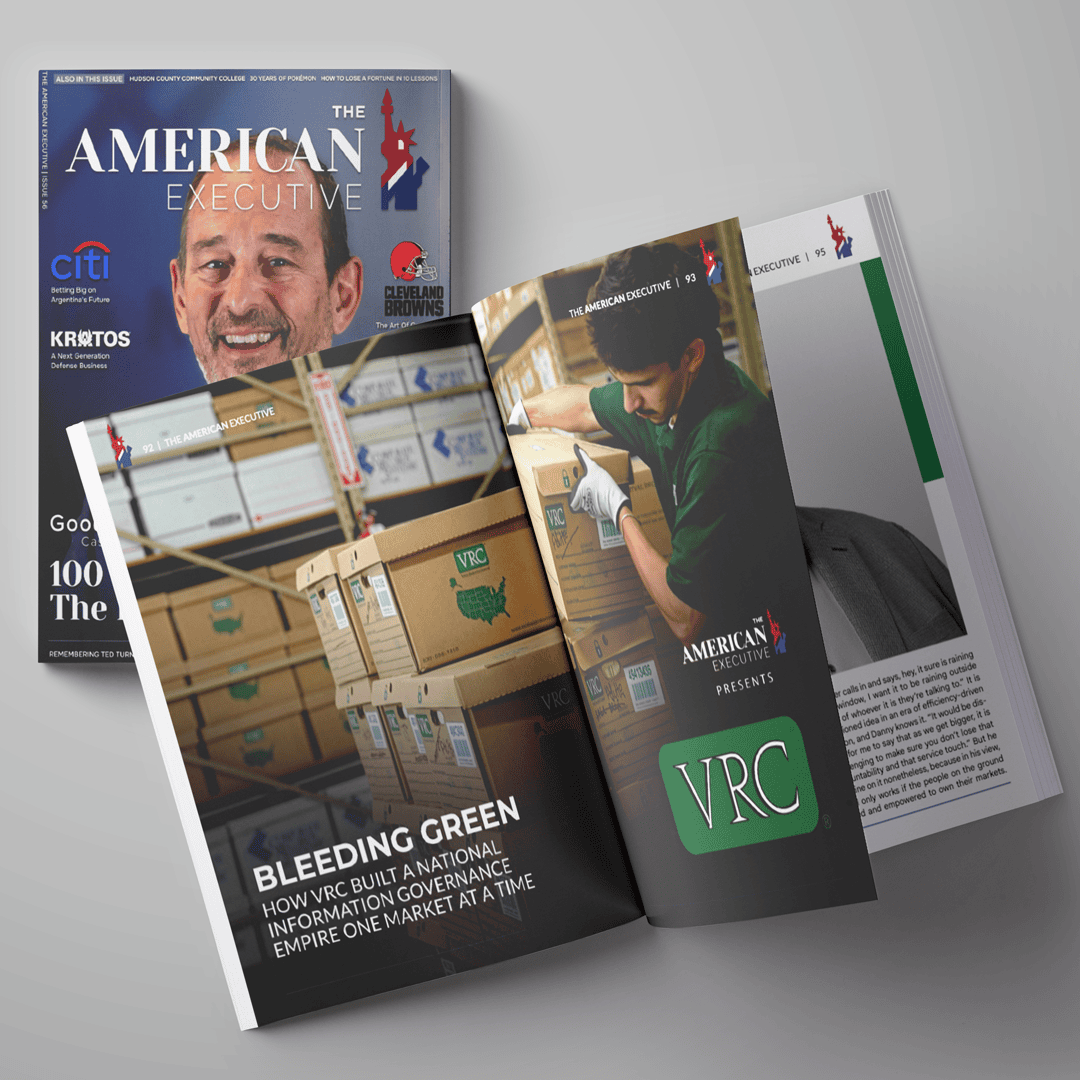
VRC President and CEO Danny Palo is featured in Issue 56 of The American Executive, in an eight-page profile titled “Bleeding Green” that traces how VRC grew from a regional records company into a national information governance provider.
Four decades, one company
Danny joined VRC in 1985 as a part-time driver, straight out of high school. He worked through nearly every level of the organization over the following two decades, became Chief Operating Officer in the mid-2000s, and stepped into the CEO role in 2017. Forty years after that first job on the docks, he leads a company operating in roughly 100 markets nationwide with approximately 2,400 employees.
That path shapes how VRC runs today. The people making decisions about warehouse operations, driver routes, and customer service have generally done those jobs themselves.
National reach, local ownership
VRC’s growth has been deliberate about one thing in particular: staying local while scaling nationally. Every VRC market operates with its own customer care team and its own local manager. There is no centralized call center routing every question to a single queue.
The reasoning is simple. When you call VRC, you reach someone who works where you work — someone who knows your account, your facility, and your market. As the company has grown, protecting that has taken real effort, and Danny is candid in the feature that it gets harder with scale rather than easier. It remains a deliberate choice.
The full information lifecycle
Information governance covers several distinct disciplines, and most providers specialize in one or two. VRC works across all of them — secure storage and retrieval, secure destruction, healthcare release of information, and digital transformation — through VitalRecords, VitalShred, VitalChart, and VitalECM.
That range is the point. Organizations rarely have a records problem confined to a single format. Paper and digital information have to be governed together, and the handoffs between them are where compliance risk tends to concentrate.
Technology built in-house
VRC has developed and controlled its own technology stack since early on rather than licensing someone else’s. The company adopted RFID tracking in 2005, when the labels were expensive and the primary buyers were the Department of Defense and Walmart. Two decades later, RFID is standard in VRC’s workflows — and customers are not charged extra for it.
What comes next
VRC has been in business for 40 years, but has only operated coast to coast for the last five or six. The company doubled in size over the past four years, and its current strategic plan calls for doubling again within five.
“I really feel like we’re just getting started,” Danny told The American Executive.
Read the full feature in Issue 56 of The American Executive (pages 92–99).
Ready to talk about your information governance program? Contact our team to find out what VRC can do for your organization.
Share this post

Resources
Latest Industry Insights
Stay informed with our expert perspectives on information management trends.

AI-Powered Document Retrieval: How Intelligent Queries Are Transforming Data Access
Read More

Get in Touch with Us.
See how we can help protect your records and documents throughout their life cycle.
